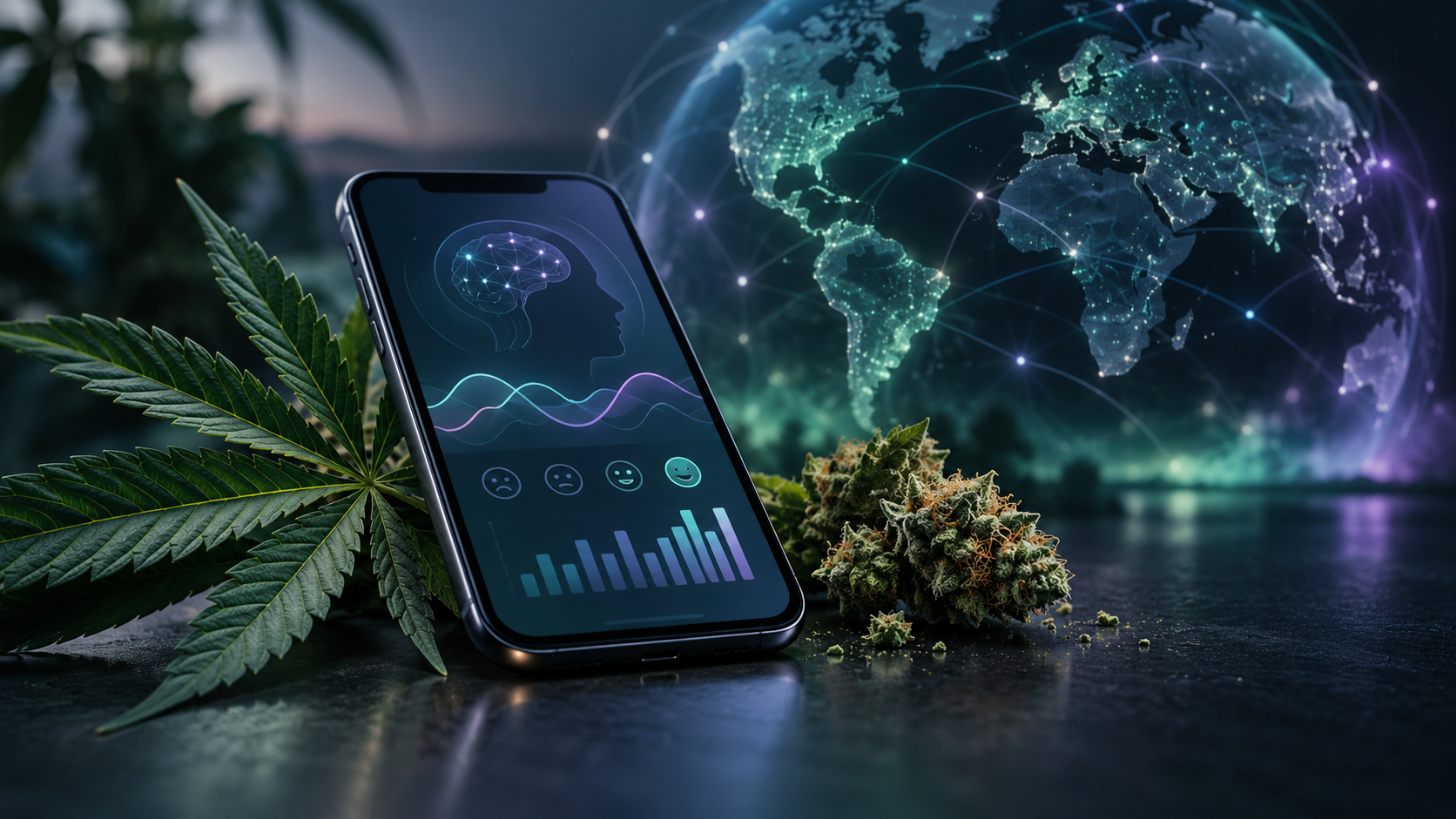
Researchers Want to Know What Cannabis Actually Does to Us in the Real World
A new international study will follow 1,800 regular cannabis consumers for two years, tracking mood, sleep, cognition, potency, stigma and what happens in the hours before and after they get high.
Cannabis research has had a pretty obvious problem for decades: wildly different consumers are often treated as if they’re doing roughly the same thing.
Someone taking a 5-milligram edible before bed can wind up in the same broad category as someone smoking flower throughout the day or taking multiple concentrate dabs. Medical consumers are mixed in with recreational consumers. People living in mature legal markets are compared with people living under prohibition.
Then we ask a question so broad it almost becomes meaningless: Is cannabis good or bad for your mental health?
A new international cannabis mental health study called “Blowing Minds” is trying to get past that.
Led by researchers at Erasmus University Rotterdam in the Netherlands, the study plans to follow approximately 1,800 regular cannabis consumers for two years. The goal is to collect a much more detailed picture of what people use, why they use it, how they feel before and after consuming and how those patterns change over time.
The project includes participants in the Netherlands, Brazil, Canada and the United States, with plans to expand into parts of Africa and Asia.
The American portion is particularly interesting because researchers are recruiting in Texas and California, two states with dramatically different relationships to cannabis.
California has operated a legal adult-use market since 2018. Texas remains far more restrictive.
That gives the researchers something more interesting to work with than THC percentages alone. They can look at whether legality, stigma, access, family attitudes, community norms and a person’s own beliefs about cannabis have any relationship to how that person experiences it.
That context has often been missing.
A Cannabis Study That Lives in Your Phone
Participants must be between 18 and 65 and currently consume cannabis at least four times a week. The study includes recreational consumers, medical consumers and people who use cannabis for both reasons.
They begin with extensive questionnaires covering consumption habits, preferred products, methods of use and estimated potency, along with physical health, sleep, psychological history and previous trauma.
Participants also complete online cognitive testing designed to measure memory, processing speed, emotional perception and other areas of brain function.
Then the study leaves the laboratory behind.
For 14 days, participants carry what amounts to a cannabis research diary in their phones.
Each morning they report how they slept and whether they used cannabis or other substances the previous day. Five more times throughout the day, the app sends random prompts asking about mood, stress, cravings, anxiety, loneliness, happiness and physical pain.
There’s another important step: participants are asked to open the app immediately before consuming cannabis.
That gives researchers a snapshot of what was happening before someone got high instead of relying entirely on what that person remembers weeks or months later.
Maybe they were stressed. Maybe they were in pain. Maybe they were anxious, bored, happy or simply following a routine they’ve repeated for years.
Once that information is compared with later check-ins, researchers may be able to see how mood shifts around individual cannabis sessions and whether certain emotional states consistently precede use.
That’s a very different way of studying cannabis than asking someone six months later whether they think it helps their anxiety.
Human memory is messy enough without asking it to reconstruct hundreds of highs.
Looking at the Highs and the Lows
The project also avoids another familiar trap in cannabis research: starting from the assumption that the plant must either be helping people or hurting them.
The team is looking for both positive and negative outcomes.
That sounds obvious, but the public debate around cannabis rarely works that way.
There are consumers who say cannabis helps them manage pain, anxiety, insomnia, PTSD symptoms and other conditions. There are also legitimate concerns surrounding heavy use, cannabis use disorder, paranoia and adverse mental health outcomes, particularly among people who may already be vulnerable.
Those experiences don’t necessarily contradict each other.
The problem comes when every form of cannabis consumption gets reduced to a single variable.
A person taking a low-dose edible a few nights a week simply isn’t engaging in the same behavior as someone repeatedly consuming high-potency concentrates throughout the day. Product, dose, frequency, age, underlying health, genetics and reason for use can all matter.
Blowing Minds is attempting to keep more of those differences intact.
One area the researchers plan to examine is whether habits such as repeatedly turning to high-potency cannabis during periods of negative emotion are associated with poorer outcomes over time.
If identifiable patterns do emerge, that could move the conversation away from blanket warnings about cannabis and toward something consumers can actually use: which behaviors appear to carry more risk, for whom, and under what circumstances.
Two Years, Not Two Weeks
The intensive phone tracking lasts only 14 days, but the study continues well beyond that window.
Participants will be contacted again after one year and two years and asked to repeat mental health assessments and cognitive testing.
That allows researchers to look at trajectories instead of snapshots.
A consumer’s habits may change. Their preferred products may change. Their tolerance, mental health, living situation or reasons for using cannabis may change too.
Some may consume more over time. Others may consume less. Someone who initially uses cannabis socially may begin using it primarily for sleep or stress. A medical consumer’s symptoms may improve while another person’s relationship with cannabis becomes more problematic.
Following the same people over a longer period gives researchers a chance to see those shifts instead of treating cannabis use as a fixed behavior.
It may also shed some light on whether those patterns look different depending on where someone lives.
A consumer in California has access to a regulated adult-use marketplace with labeled products and licensed stores. A consumer in Texas operates in a much different legal and cultural environment.
That difference alone won’t prove that one system produces better mental health outcomes than another, but it gives researchers another piece of the puzzle.
There Aren’t Any Answers Yet
For all the promise of the project, Blowing Minds hasn’t produced results yet.
The study protocol has been published in the journal Comprehensive Psychiatry. What exists today is the research framework, not the conclusion.
And there are limitations.
Much of the cannabis data is self-reported. Participants are estimating potency rather than having every product independently tested. Any long-term study also has to contend with people dropping out, ignoring phone prompts or providing incomplete information.
Running the project remotely creates another challenge: making sure the person filling out the surveys is actually the person enrolled in the study.
The team says it has built security checks and statistical methods into the project to deal with those problems, but no study design makes them disappear completely.
Still, the approach is worth watching because it acknowledges something cannabis research has too often glossed over.
Cannabis isn’t one product, and cannabis consumers aren’t one population.
“Cannabis use” can mean a grandmother taking a low-dose gummy for arthritis, a medical patient vaping before bed, someone passing a joint at a concert or a heavy consumer taking concentrate dabs throughout the day.
Those aren’t interchangeable behaviors.
If researchers really want to understand the relationship between cannabis and mental health, they need to know more than whether somebody checked “yes” next to a question asking if they use it.
They need to know what that person consumed, how much, how often, why they reached for it, what was happening in their life at the time and what happened afterward.
That’s what makes Blowing Minds interesting.
Cannabis science has spent years trying to squeeze a complicated plant and millions of very different consumers into a simple debate over whether cannabis is good or bad.
The answer was probably never going to be that simple.